
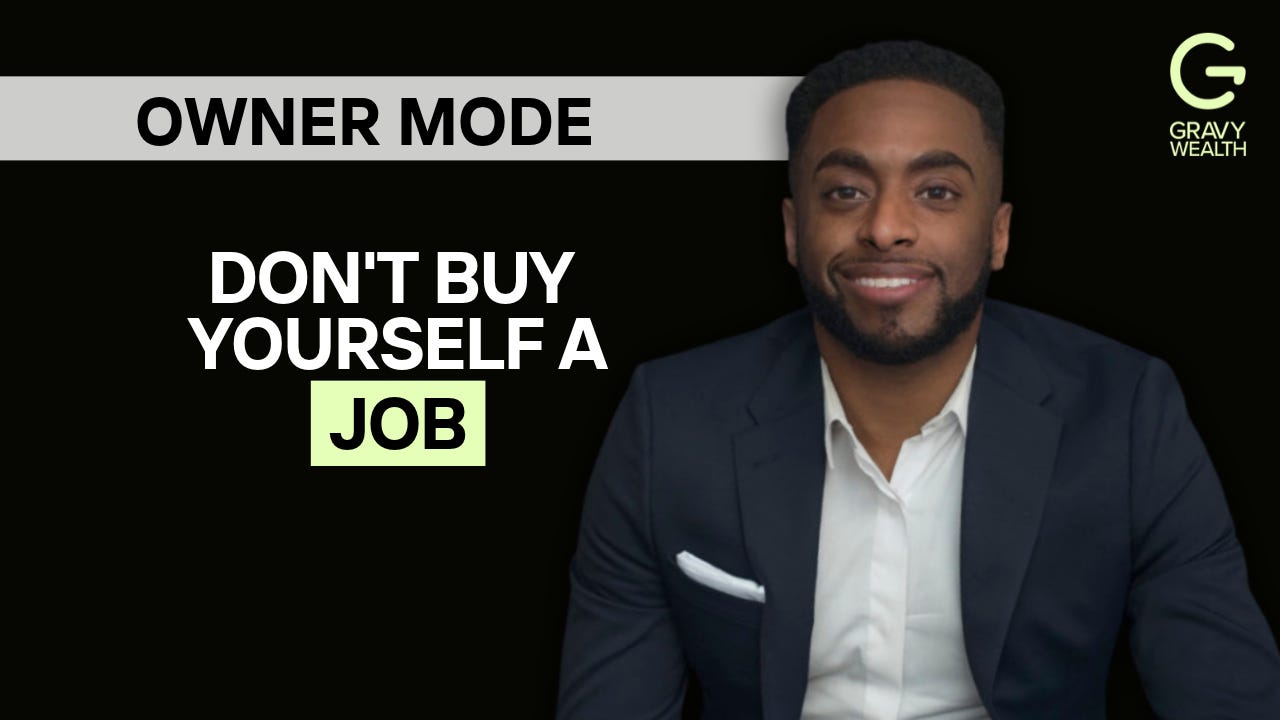
Franchising gets sold as the proven way out of a salary. Chequan Lewis, who now runs a franchise brand, warns that it can just as easily become a second job.
Chequan is the CEO of Crunch Fitness, where he leads enterprise strategy and franchising operations. He came to franchising from the law. He was a litigator in Dallas when he took a job as a franchise lawyer, knowing little about franchising beyond the places he ate at, on the bet that being inside a franchisor would get him into the business. It did. He went on to run a nontraditional restaurant business he puts at roughly $450 to $500 million, then served as Pizza Hut's first Chief Equity Officer and later its COO.
His first filter is personality. Franchising suits the person who wants to take a brand that already resonates and execute it well. For a founder who needs the whole DNA of the business to come from them, he says franchising could be off, because the franchisor has already done that work.
His second is risk, in three parts. Capital risk is the obvious one. Interpersonal risk gets talked about less: a franchise owner never really gets to turn it off, and the people closest to them live it too. Emotional risk cuts both ways, between regretting never taking the chance and regretting taking it without doing the work. In his words, "I've yet to see a story that I really admired that didn't have risk in the soil in it."
From there he gets practical. Ask any franchise broker how they are paid. Talk to franchisees already inside the brand. Check the unit economics against the peer group, whether the brand has grown with discipline, and how well it supports its operators. And watch the three C's franchisors screen for: capability, capital and commitment.
Three takeaways from the conversation
Decide what it needs to pay you before you pick a brand
Chequan's threshold question is whether the franchise needs to replace your income. On a thin-margin unit, the P&L can only carry so much cost, so paying a manager can leave too little to replace a salary. In his telling, that is how it becomes very easy to buy yourself a job and not realize it, and why income replacement usually means a plan for several units.
Check the incentives, then call the owners
Chequan points out that a broker paid only when a buyer says yes has less reason to care whether that buyer succeeds. His advice is to ask every broker how they get paid, then go talk to existing franchisees, which he calls a better barometer than anything.
Capital is the easy C
Chequan's read is that capital is the straightforward part of the three C's. The friction between franchisees and franchisors tends to start with capability, the discipline to do the little things well every day, and commitment, meeting the growth a franchisee signed up for.
Watch the full conversation
About this guest
Chequan Lewis is CEO of Crunch Fitness, where he leads enterprise strategy and franchising operations across a globally recognized fitness brand. A former COO of Pizza Hut and the company's first Chief Equity Officer, he brings deep experience scaling consumer brands and aligning franchise partners. He is a Harvard Law School graduate and a Presidential Leadership Scholar.
Resources
Explore the Acquire pathway: gravywealth.com/acquire
Take the complimentary Ownership DNA Assessment and see how you compare to other professionals making the shift. Methodology reviewed by Archie Jones, Senior Lecturer at Harvard Business School. go.gravywealth.com/DNA
Subscribe to Owner Mode on YouTube: youtube.com/@gravywealth
The Owner Mode podcast on Apple, Spotify, and everywhere podcasts live: gravywealth.com/podcast
Owner Mode publishes a new session every Monday. New here? Subscribe to follow along.
The Owner Mode Memo breaks down the sessions. Gravy Wealth brings the pathways, the tools, the operators, and infrastructure to shift from earner to owner. Explore it at gravywealth.com.