
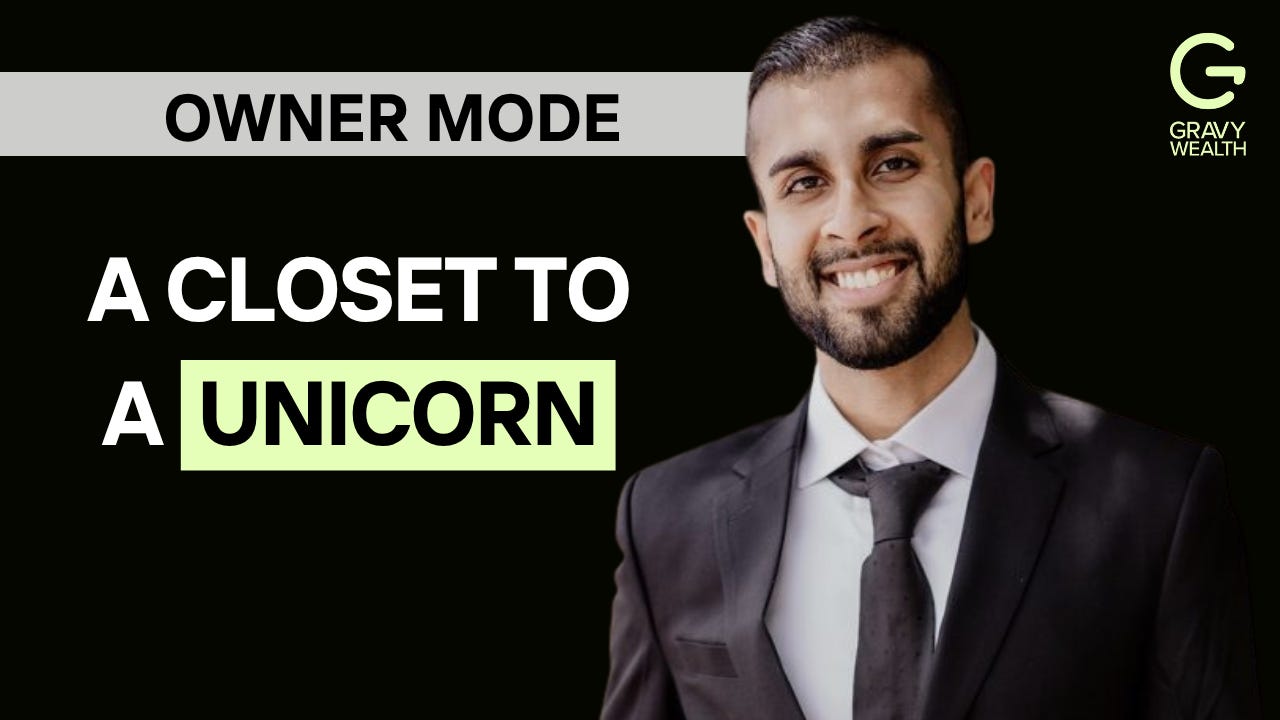
Most billion-dollar company stories start with a clean origin and a big check. Samir Goel’s started with a wall.
It was the wall his family hit when they immigrated from India and found that working hard and paying on time meant nothing without a credit history. His co-founder Wemimo Abbey had a parallel story, immigrating from Nigeria with his mother, who took out a 400% payday loan when they arrived. Esusu, the company they built together, was built to take that wall down.
The insight is mechanical and almost obvious in hindsight: rent is the largest, most consistent monthly payment in tens of millions of households, and it had never been used to build credit. Forty-five million Americans are credit invisible. Esusu routes their rent payments to the three major credit bureaus, the same way a mortgage builds credit for a homeowner. Today the company is valued at $1.2 billion, reaches 12 million renters across 5 million units, and has helped unlock $30 billion in mortgages.
The model took three pivots to find. Selling rent reporting directly to renters meant asking strangers for their Social Security number and bank account, and it failed. The unlock was selling to the landlord instead, the party that already held the trust and the budget, and letting the credit benefit flow downstream. Blackstone, Related Companies, Fannie Mae, and Freddie Mac became clients.
What makes this an Owner Mode story is how Samir got there without burning the boats. He ran sales and strategy operations for LinkedIn’s $500M EMEA business unit and built Esusu on nights and weekends for two and a half years, then bootstrapped for 18 months on $100K in credit card debt, with NYU loans in collections and a closet in Harlem rented half-out on Airbnb to cover the bills.
Three takeaways from the conversation
Piggyback on existing trust
Samir breaks down why the first version of Esusu stalled: selling rent reporting to renters meant asking strangers to hand over their bank account and Social Security number. The unlock was routing through the landlord, the party that already held the relationship and the budget, and letting the credit benefit flow downstream. His phrase for it is to piggyback on existing trust, and that single B2B2C move turned a stalled product into a $1.2 billion company.
Venture capital is a mortgage
Samir’s read on the money most founders chase is that it is an obligation, not a reward. Venture capital, he says, is a mortgage, with a rate of return you have to pay off. He bootstrapped for 18 months on $100K in credit card debt before he raised a dollar, so he named that obligation before he signed for it, a discipline most founders only acquire after the fact.
Build the plan around no safety net
Samir describes a 2.5-year side hustle while running a $500M unit at LinkedIn, making the jump only when the company had real traction and investors signaled they would not fund part-time founders. He and his co-founder did not come from money and had no cushion to fall back on. His move was to engineer every inch of runway he could rather than wait for a safety net that was never coming.
Watch the full conversation
About this guest
Samir Goel is Co-Founder and Co-CEO of Esusu, the leading fintech platform using rent data to build credit and expand financial access. Esusu is valued at $1.2 billion, reaches 12 million renters across 5 million units, and has helped unlock $30 billion in mortgages for people who were previously credit invisible. Prior to Esusu, Samir led Sales Strategy and Operations at LinkedIn for a $500 million business unit across EMEA. He also co-founded Transfernation, a nonprofit that rescued over 5 million pounds of food and impacted 2.5 million lives. He studied at NYU Stern.
Resources
How Gravy Wealth helps high earners shift into ownership: gravywealth.com/launch
Take the complimentary Ownership DNA Assessment and see how you compare to other professionals making the shift. Methodology reviewed by Archie Jones, Senior Lecturer at Harvard Business School. go.gravywealth.com/DNA
Subscribe to Owner Mode on YouTube: youtube.com/@gravywealth
The Owner Mode podcast on Apple, Spotify, and everywhere podcasts live: gravywealth.com/podcast
Owner Mode publishes a new session every Monday. New here? Subscribe to follow along.
The Owner Mode Memo breaks down the sessions. Gravy Wealth brings the pathways, the tools, the operators, and infrastructure to shift from earner to owner. Explore it at gravywealth.com.